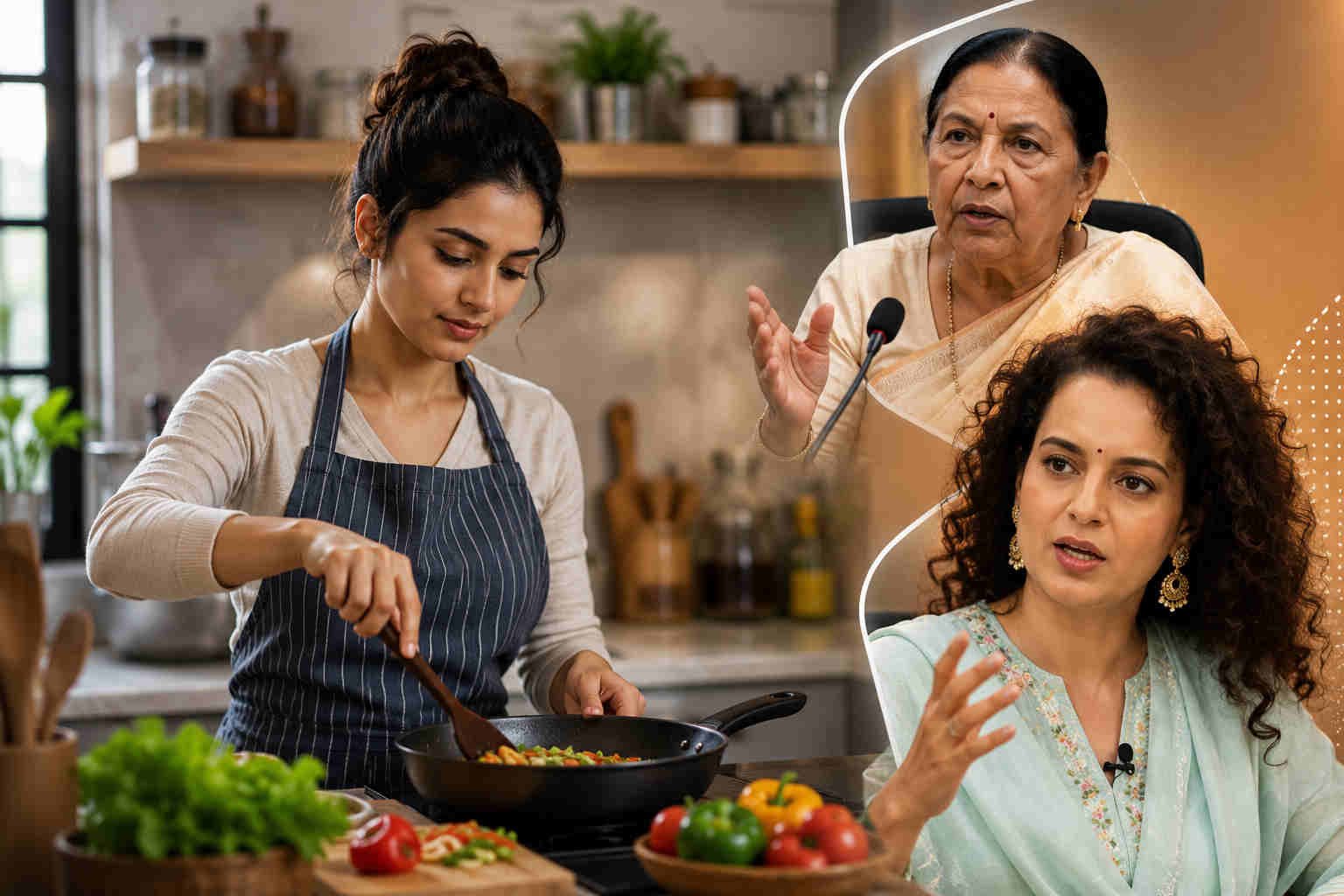
BJP MP Kangana Ranaut is always known for her vocal comments. This time the actress is in news for her views in favour of Uttar Pradesh Governor Anandiben Patel’s remarks asking young women to learn cooking at an event.
In response to the her comment on social media platform X, there were mixed reactions. Some criticized the comments for suggesting that cooking is a woman’s job. Others contend that it is not gender-oriented but life-oriented.
Should young women learn to cook? The debate indicates a more nuanced answer than it appears.
What is the importance of cooking in our lives?
Cooking is one of the rare skills of life that incorporates health, independence, financial literacy and self-care. In short, those who live away from home, young professionals are eventually raising a family, learning how to whip up nutritious meals can foster healthier eating habits and lessen the reliance on packaged food or costly takeaways.
For a long time, nutritionists have associated home-cooked food with superior dietary quality and greater control over the meal’s composition. Thus, cooking is a practical skill to have as it offers long-term benefits.
Does Indian Culture Promote Cooking?
Indian traditions have always viewed food as more than just nourishment. Verses in ancient texts like the Taittiriya Upanishad say “Annam Bahu Kurvita” (Let food be abundant) which stresses on preparing and feeding more. The cultural of Atithi Devo Bhava lays the hospitality and providing food right at the heart of family life.
This was a role that was historically done by women, but the values associated with it – care, nourishment and hospitality – were never intended to belong to one gender.
Do Women Have Better Nurturing Instinct?
The argument gets more complicated from here.
Studies indicate that, on average, women tend to have higher scores for empathy and caregiving behaviours. Scientists think that biological factors such as the hormone oxytocin may be involved. However, researchers believe that upbringing, culture, education and social expectations play a large role in nurturing behaviour. Compassion and caregiving are human traits, not skills exclusive to women.
The Reason for Debate.
Critics claim that in only asking young girls to learn cooking, one reinforces old stereotypes as today’s households are more about sharing than anything else. Most people feel the discussion must also include men. That will help in making cooking a universal life skill rather than a gender expectation.
Supporters, though, say that encouraging cooking among young women is not automatically regressive. Learning how to cook does not affect your ambitions in life. If a woman is a CEO, scientist, entrepreneur or artist, she can still appreciate having the ability to put a healthy meal on the table. No skill cancels out another skill.
A Wider Viewpoint.
Rather than asking should women learn how to cook, the better question might be “Should every young person learn to cook?”
The answer, it seems, would be yes for many.
Preparing meals can help you become self-reliant and live a healthier life with homecooked food. Instead of thinking about it as a chore for one gender, it can be seen as an essential life skill for everyone.
If the discussion or this conversation encourages more young people—women and men alike—to see cooking as a valuable skill rather than a stereotype, it may ultimately move the debate in a more constructive direction.