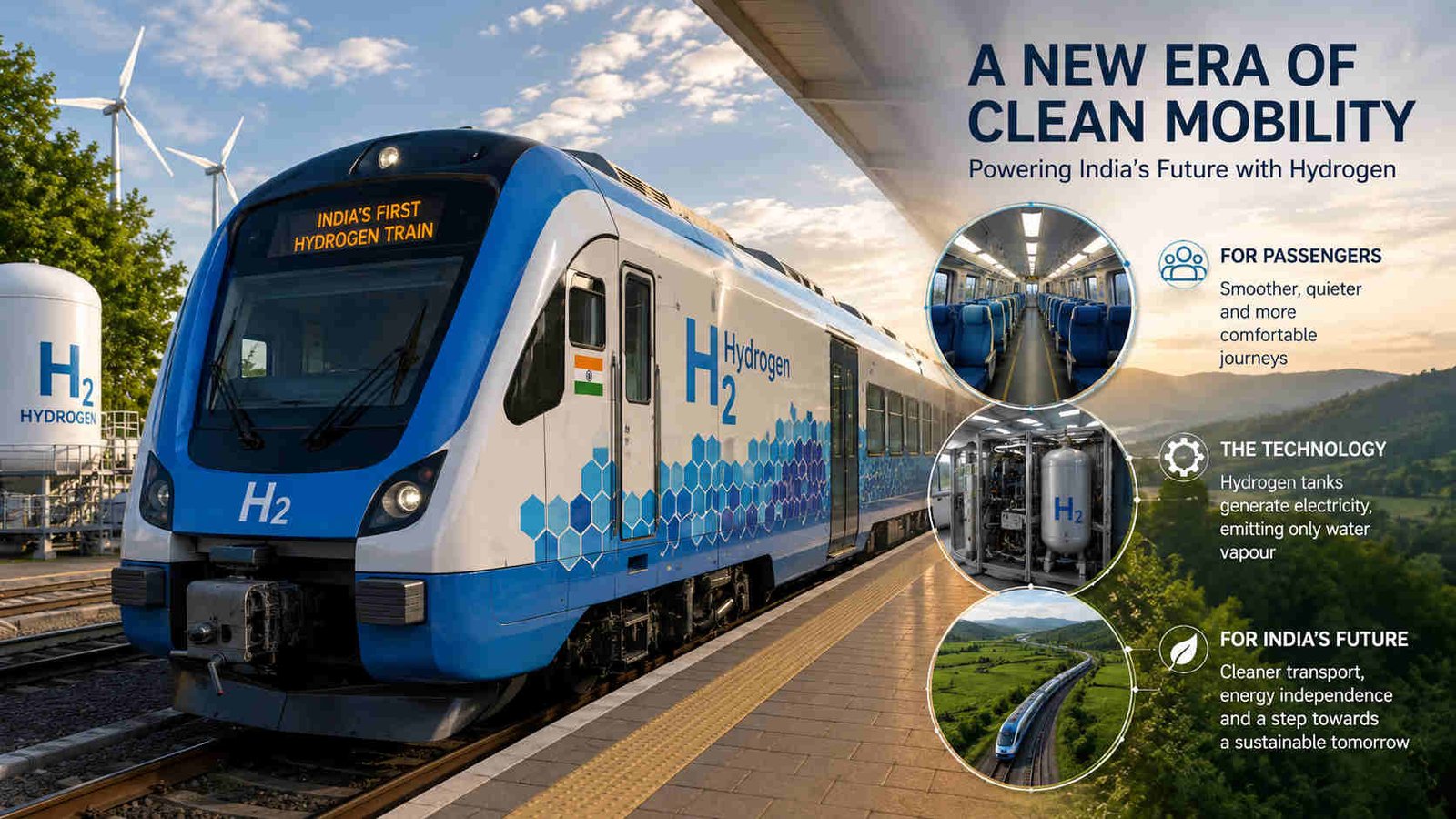
India’s First Hydrogen Train: What It Means for the Common Man
Prime Minister Modi just flagged off India’s first hydrogen-powered train from Jind Station to Sonipat, Haryana on 17thJuly 2026.
While the news may sound highly technical for a common man, but we will break the basic idea in simple terms for your understanding.
We are forwarding to a sustainable railway transport environment. For day-to-day travelers, trains are not going to suddenly appear very different. In terms of how the locomotive manufactures energy, how clean it is and what it could mean for the Indian Railways, real change is happening within the engine system.
This newest addition to India’s indigenous technology development will feature electricity generation from hydrogen cells instead of diesel. And the most promising part- zero carbons emissions.
What is a hydrogen train? Technology explained
A hydrogen train runs on electricity produced by hydrogen fuel cells, instead of a diesel engine. The train does not burn diesel, but instead, stores hydrogen gas. Inside the fuel cell a chemical reaction between hydrogen and oxygen that takes place. This process generates electricity that drives the electric motors of the train. The key part is the process does not produce smoke/carbon from a diesel-powered engine. The major by-product is water vapour.
How does it work in simple terms?
Think of it like this:
- Diesel trains burn fuel directly to create power.
- Electric trains take power from overhead wires.
- Hydrogen trains carry hydrogen on board and create electricity while running.
Unlike traditional diesel train, a hydrogen train can be termed as a small mobile power station. It produces electricity inside the train and doesn’t rely much on power from electric lines.
What prompts India to take such an initiative?
To reduce pollution and diesel dependence, Indian Railways will run more trains on diesel on not fully electrified routes. Quite a few regional and heritage routes continue to use diesel locomotives because putting in place overhead electric infrastructure everywhere can be quite expensive and time-consuming. Hydrogen trains present a potentially viable alternative for such routes. They can operate without diesel power and without the need for overhead wires.
What benefits does it have?
The advantages may include for the average passenger.
• Air near railway stations and routes will be cleaner.
• Diesel engines create less noise than this.
• Decreased smoke and emissions.
• A transportation system that is kinder to the environment.
India will benefit in many ways like it will become less dependent on fossil fuel, facilitate green hydrogen technology and cleaner public transport.
What is the technical benefit?
Hydrogen fuel cells are capable of generating electricity onboard, which is their main technical advantage. They are beneficial for routes where complete electrification is challenging. Hydrogen trains are expected to be cleaner than diesel trains. When compared to battery-only trains, hydrogen trains may have a longer range because hydrogen stores more energy for its weight.
Yes. Hydrogen trains are promising, but they are not simple to deploy. India will need:
- Safe hydrogen production.
- Storage and refuelling facilities.
- Special maintenance systems.
- Trained railway staff.
Green hydrogen — hydrogen produced using renewable energy — is also still expensive. That means the technology may take time before it becomes widely used.
What does this mean for passengers?
For the time being, the difference will not be grand for the passenger. The train will still take them from one place to another. However, it may be cleaner, quieter, and more modern. Over the years, if the technology is successful, India might deploy hydrogen trains on additional non-electrified routes, thereby cutting down use of diesel across the railway network.
The bigger future
India’s first hydrogen train is important because it is more than just a new train with a record of being the world longest and most powerful hydrogen fuelled train for passengers. India has the world’s largest railway network and it needs a cleaner fuel technology that can work at scale.
If successful, hydrogen trains could become part of India’s larger push toward sustainable transport, alongside electric trains, electric vehicles, and renewable energy.