Ten years ago, a digital payment could mean typing in a bank account number, IFSC code or card details, or waiting to be swiped or clicked on. Buying a cup of chai, splitting a restaurant bill, paying an auto driver or shopping at a local kirana store could take minutes, if not hours: write down a PayTM number, wait for a QR code to load, enter a phone number.
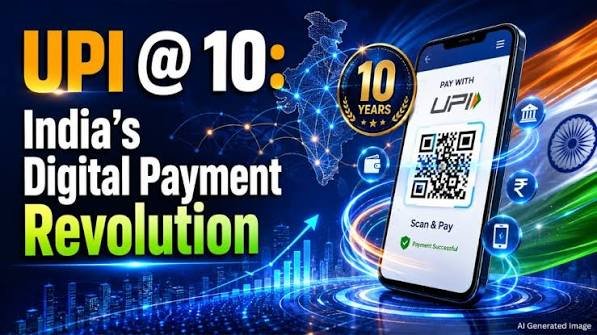
Not today. The Unified Payments Interface, or UPI, launched in August 2016 by the National Payments Corporation of India (NPCI) under the Reserve Bank of India’s oversight, completed 10 years in August 2026. Over the last decade, it has grown into the central nervous system of India’s everyday digital-payment universe. It has averted the need for remembering complex bank account details to send and receive money: a UPI ID, phone number or scanned QR code is enough.
The result is visible in how Indians pay now, for everyday purchases or surprise expenses. In FY 2025–26, 86% of person-to-merchant UPI transactions were under ₹500, a sign of how deeply it has embedded itself in people’s lives.
The Teller Behind the Transaction
UPI has seen exponential growth in the volume of transactions and in the value of those transactions. In FY 2016–17, transaction volume was 1.78 crore. In FY 2025–26, it increased to more than 24,162 crore, representing an almost 13,000-fold growth in volume of transactions. Over the same period, the total value of transactions increased from ₹0.07 lakh crore to ₹314 lakh crore.
In July 2026, UPI processed a record 2,366 crore transactions in a month. It now accounts for about 84% of India’s digital payment transactions by volume, and nearly 49% of global real-time payments transactions.
The Ecosystem It Built
UPI’s most significant contribution is its power: it has democratised everyday digital payments in India in scale and speed. But it has also made them accessible. Small merchants no longer need to invest in costly card machines to accept digital payments; a printed QR code and a bank account are often enough.
Consumers feel the speed, too. Making payments is easier, faster and, with real-time transfer and tracking, more immediate. Payment histories inside banking and UPI apps have also helped users see where money is going and how much they spend. Bill splitting, recurring payments and instant money transfers have simplified everyday money management.
UPI has also broadened the formal payments net. The UPI network expanded from 44 banks in FY 2016–17 to 754 banks in FY 2025–26, connecting consumers across urban, semi-urban and rural markets.
The Road Ahead
UPI is now live in 11 countries, supporting India’s ambition of being an exporter of digital public infrastructure. But a lot more needs to be done to make the network more sustainable, secure and reliable, especially with volumes set to scale.
One thing is clear: UPI has made a smartphone into a wallet, a payment terminal and a bank branch. At 10, it has changed not only how India pays, but also what Indians expect from money: instant, frictionless and available everywhere.