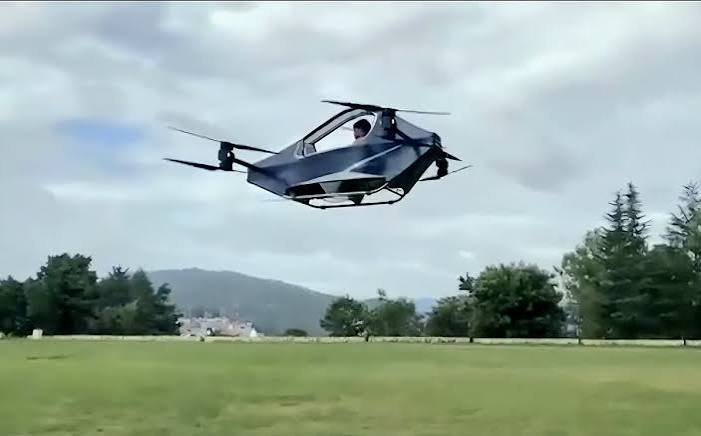
An Uttarakhand innovator has test-flown the electric Hapida Skynex. Here’s how flying vehicles work, where eVTOLs are being tested and how practical they could be in India.
Imagine being able to take the same route to work tomorrow, but instead of driving on the road or zooming along on a train, you’re doing it in the sky. Well that future might be slightly closer than you think. In Uttarakhand, Ravi Tamta of Almora recently conducted the successful maiden flight of a single-seat electric flying vehicle after 13 years of trial and development.
Called Hapida Skynex, the electric vertical take-off and landing prototype flew during a supervised test from a helipad located in Almora. Tamta took off vertically for 40 seconds before landing successfully. Built with homegrown technology with budgetary and technical constraints, Tamta says further test flights will help ready the aircraft for better safety measures as well as passenger capacity and performance.
But first, what is an electric flying vehicle? Could you really one day use this mode of transport to travel to work, school or the shops?
What Is an Electric Flying Vehicle?
An electric flying vehicle falls under the larger umbrella of electric vertical take-off and landing aircraft technology, often referred to as eVTOL.
VTOLs differ from traditional aircraft because instead of requiring a runway to take off and land, VTOLs take off vertically using multiple electric motors and propellers. Some prototypes are capable of ‘transitioning’ into forward flight, effectively making them part helicopter, part aeroplane.
Electric flying vehicles are seen as having application in air taxis, emergency services, cargo, logistics and even short-distance travel in urban environments.
What Powers It?
Electric flying vehicles use electric motors as a propulsion system. Power drawn from on-board batteries feeds several motors which power propellers or rotors. These then provide lift and thrust.
Multiple motors are also useful because it adds redundancy to the propulsion system, should one of the motors fail. However, one of the biggest challenges with electric flying vehicles remains the battery. Aircraft need a lot of energy to fly, but must also be extremely lightweight. While batteries are getting more efficient, a 2026 study shows that battery technology still faces hurdles in terms of weight, energy-density and thermal management.
Are There Flying Taxis Already in Use?
Yes. Actually, they’re not just being tested here in India.
Chinese companies EHang and Volocopter, US-based Joby Aviation, UK firm Vertical Aerospace, and Uber’s Elevate division are all developing electric VTOL aircraft. The United Arab Emirates is also working towards eVTOL air-taxi services for the city of Dubai.
While several of these companies are still testing their aircraft, some have moved past the trial phase. Chinese VTOL manufacturer EHang has started commercial autonomous passenger operations, selling tickets for the rides. Chinese regulations allow pilots on EHang flights to oversee the autonomous technology, taking control if anything goes wrong.
How Feasible Are They for India?
Like cars, personal air vehicles won’t happen overnight. There’s still plenty of work to do. Certification will be a long and complicated process. Battery range still needs improvement. Passenger capacity and safety features need refining. Plus, more advanced air traffic control will be required to prevent our skies from turning into a knock-down, drag-out battle of who can fly highest. The list goes on: there’s also the cost of the aircraft, where they’ll land and take off, how much electricity the vehicles will consume and so on.
India will have to overcome significant infrastructure, technological and regulatory challenges before electric flying vehicles are a common sight. But that’s not to say personal air transport won’t become a thing in India. Urban air taxis, medical emergencies and tourism are all possible application areas.
Tamta’s experiment is an excellent proof of concept. But for now, the flying car remains a dream.